

 Crops & Grains
 Coffee, Tea & Cocoa
 Spices & Herbs
 Plantation Crops
 Fruits & Vegetables
 Seafood & Aquaculture
 Dairy
 Meat & Livestock
 Poultry & Eggs
 Processed & Packaged Foods
 Organic & Specialty Products
 Use cases
 Success Stories
 White Papers
 Blog
 Product Roadmap
 Our Journal
Antibiotic Rejections in Indian Shrimp Exports Why Traceability Is Now Critical for the Seafood Industry
India’s shrimp exports face rising rejections due to antibiotic residues. Learn why blockchain-based traceability is essential for compliance, transparency, and global seafood market access with FoodTraze.
India is one of the world’s largest seafood exporters, with shrimp contributing a significant share of its marine export value. However, recent developments highlight a persistent challenge that could impact the country’s reputation in global markets: antibiotic residue contamination and traceability gaps.
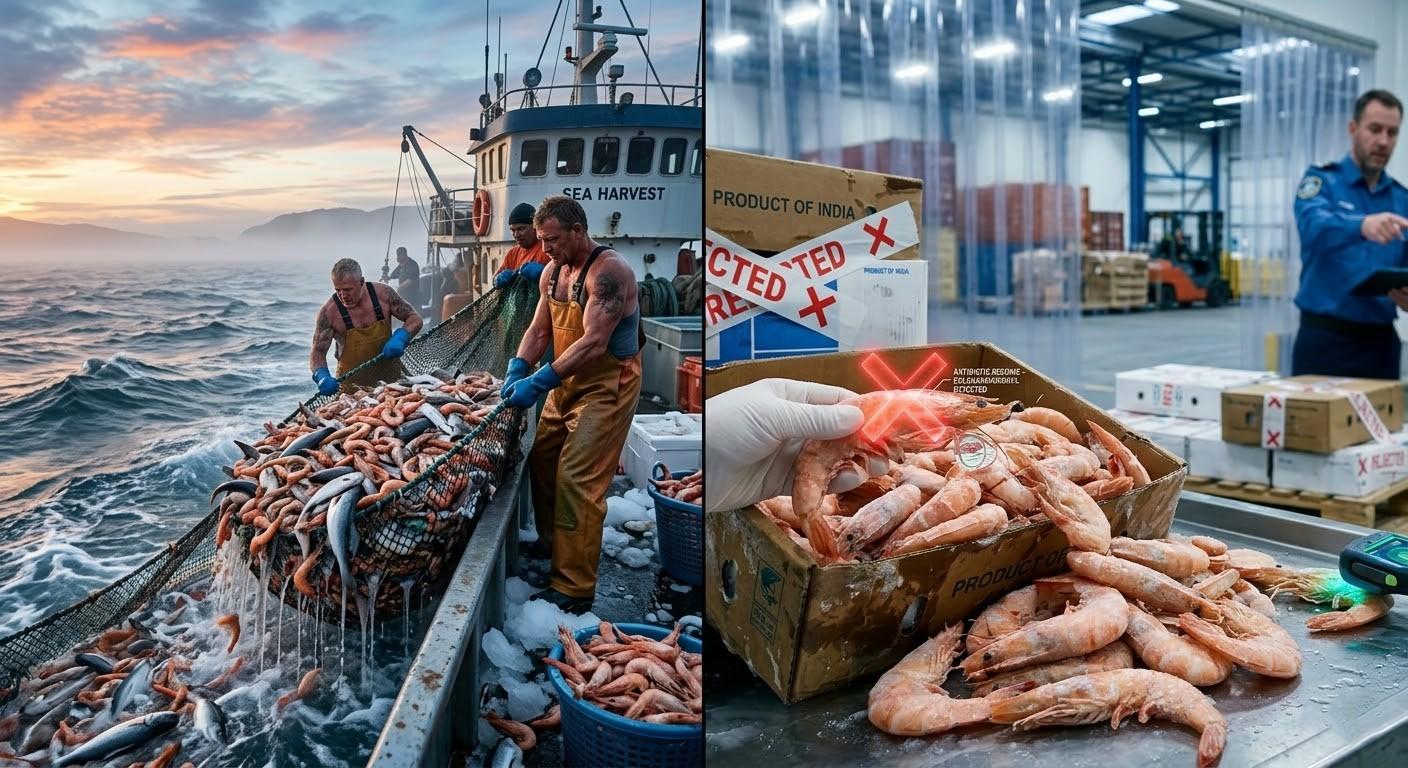
During the 2025–26 period, 19 Indian shrimp export consignments were rejected due to the presence of banned antibiotics, according to Fisheries Minister Rajiv Ranjan Singh in Parliament. Of these, 12 consignments were rejected by the United States and 7 by the European Union.
Notably, none of these rejections were linked to disease or microbial contamination. Instead, they were entirely due to antibiotic residues that violate strict international food safety standards.
This situation reflects a broader shift in global trade, where compliance, transparency, and traceability are becoming critical requirements.
Rising Global Scrutiny on Seafood Exports
Seafood-importing countries are strengthening food safety regulations and inspection processes. Markets such as the EU, US, Japan, and the UK now conduct extensive residue testing and traceability checks to ensure imported seafood meets their safety standards.
In some cases, up to 50 to 100 percent of shrimp consignments are subject to inspection, significantly increasing the risk of rejection if compliance systems are weak.
Antibiotics such as chloramphenicol, nitrofurans, and other medically important antimicrobials are banned in aquaculture due to concerns over antimicrobial resistance and consumer safety.
Even trace amounts of these substances can lead to:
● Shipment rejection at destination ports
● Significant financial and logistics losses
● Increased scrutiny or blacklisting of exporters
● Long-term damage to brand and country reputation
As a result, regulatory authorities and industry bodies in India are intensifying monitoring across the aquaculture supply chain.
Government Measures to Strengthen Compliance
To address these challenges and protect India’s export credibility, several regulatory measures have been implemented.
Coastal Aquaculture Authority
The Coastal Aquaculture Authority strictly prohibits the use of antibiotics and other pharmacologically active substances in coastal aquaculture. Violations can result in penalties and enforcement actions.
Antibiotic Task Forces
The fisheries ministry has directed coastal states to establish dedicated Antibiotic Task Forces to monitor aquaculture practices and take action against illegal antibiotic usage.
Export Inspection Council
The Export Inspection Council plays a critical role in ensuring export compliance by:
● Mandating laboratory testing for banned antibiotics
● Providing training on food safety management systems
● Monitoring certification before shipment
MPEDA Pre-Harvest Testing
The Marine Products Export Development Authority conducts pre-harvest testing at the farm level to identify antibiotic residues before shrimp reaches processing facilities.
Together, MPEDA, CAA, and EIC operate under the National Residue Control Plan to ensure Indian seafood aligns with global safety standards.
The Role of Traceability in Seafood Supply Chains
Traditional seafood traceability systems often rely on fragmented records, paper documentation, and manual reporting. These approaches create several challenges:
● Limited end-to-end visibility
● Difficulty in identifying contamination sources
● Risk of data manipulation
● Delayed response during export rejections
As global regulations tighten, these limitations are becoming increasingly problematic.
How Blockchain Traceability Can Transform Seafood Exports
Blockchain-based traceability systems offer a more reliable and transparent approach to managing complex supply chains.
End-to-End Visibility
Blockchain enables real-time tracking of seafood products from hatchery to export, ensuring every stage of the supply chain is recorded and verifiable.
Tamper-Proof Records
Once data is recorded on blockchain, it cannot be altered, reducing the risk of fraud and ensuring data integrity.
Faster Issue Resolution
In case of contamination or rejection, blockchain systems allow exporters to quickly trace the source and take corrective action.
FoodTraze Blockchain Traceability for Seafood Transparency
To address these industry challenges, FoodTraze provides a blockchain-powered food traceability platform designed for complex supply chains such as seafood exports.
Farm-to-Fork Traceability
FoodTraze captures every stage of the seafood lifecycle, including:
● Hatchery
● Aquaculture farm
● Feed usage
● Harvesting
● Processing
● Cold chain logistics
● Export documentation
Each step is securely recorded, ensuring complete traceability.
Compliance with Global Regulations
FoodTraze helps exporters maintain structured and verifiable records for:
● Antibiotic testing
● Pre-harvest certifications
● Processing standards
● Export compliance documentation
This supports adherence to strict regulations in global markets such as the EU and the US.
Enhanced Transparency
With QR code integration, buyers and regulators can access real-time information about product origin, safety, and compliance, improving trust across the supply chain.
Why Traceability Will Define the Future of Seafood Exports
The seafood industry is moving toward a model where traceability, compliance, and sustainability are no longer optional.
Upcoming regulations, including stricter traceability frameworks under global food safety laws, will require detailed data tracking across supply chains.
For exporters, adopting advanced traceability systems is becoming essential not just for compliance, but for maintaining access to international markets.
Conclusion
The rejection of 19 shrimp consignments due to banned antibiotics highlights the urgent need for stronger compliance and traceability systems in India’s aquaculture sector.
Government agencies and industry stakeholders are already taking steps to improve transparency through regulatory frameworks and monitoring initiatives.
In this evolving landscape, blockchain-based traceability platforms such as FoodTraze can play a crucial role by enabling end-to-end visibility, ensuring compliance, and strengthening trust across global seafood supply chains.
As international markets continue to tighten standards, traceability will become the key factor that determines long-term success in seafood exports.