

 Crops & Grains
 Coffee, Tea & Cocoa
 Spices & Herbs
 Plantation Crops
 Fruits & Vegetables
 Seafood & Aquaculture
 Dairy
 Meat & Livestock
 Poultry & Eggs
 Processed & Packaged Foods
 Organic & Specialty Products
 Use cases
 Success Stories
 White Papers
 Blog
 Product Roadmap
 Our Journal
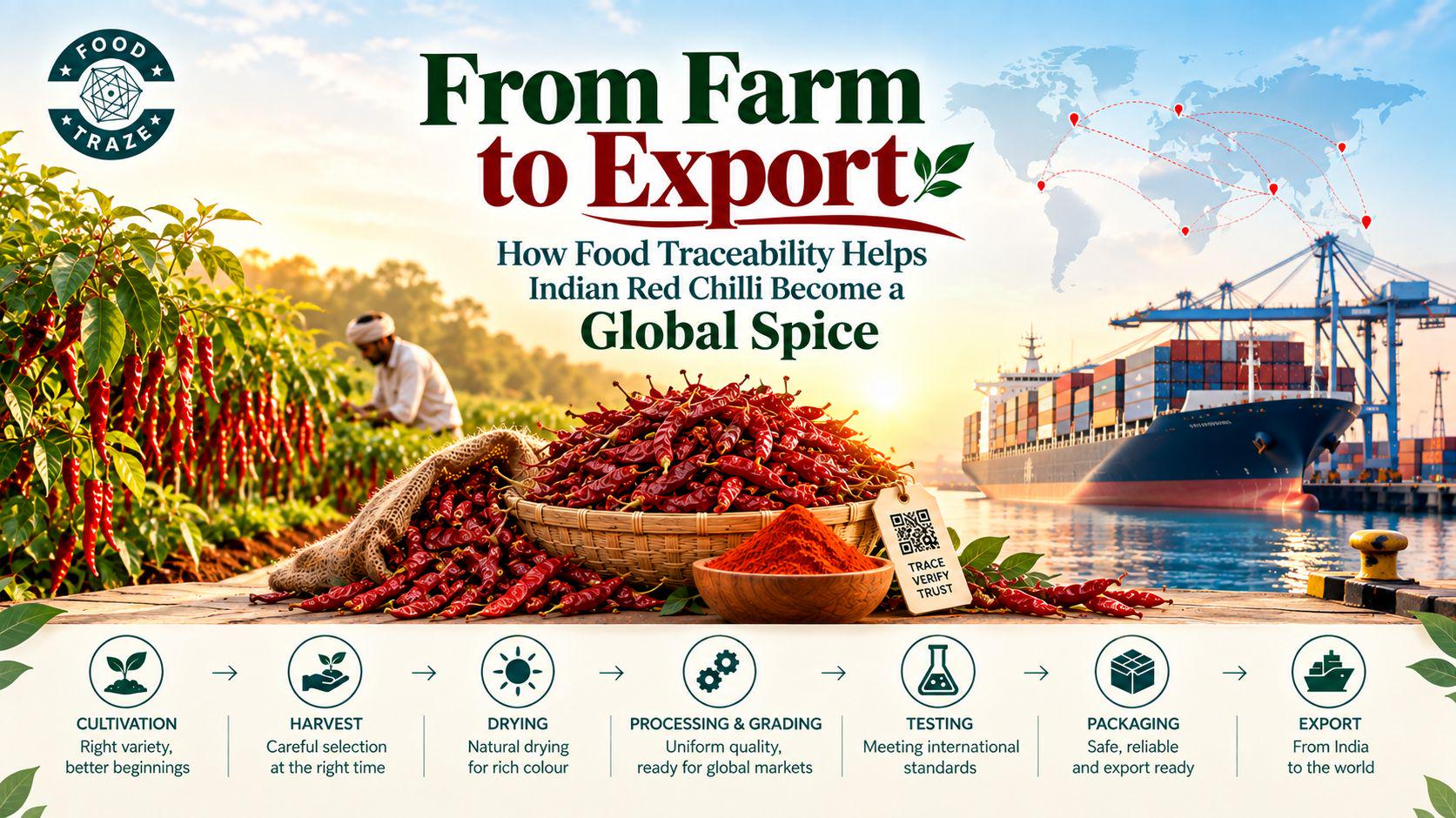
From Farm to Export How Food Traceability Helps Indian Red Chilli Become a Global Spice
Discover how blockchain food traceability can connect Indian red chilli from farm to export, improving batch visibility, quality records, testing, and supply chain transparency.
Indian red chilli is one of the country's important agricultural commodities, supplying food manufacturers, spice companies, exporters, and international buyers across global markets.
But behind every exported chilli shipment is a much longer journey.
It starts with the farmer and the field, continues through harvesting, collection, drying, processing, grading, testing, packaging, storage, and transportation, and finally reaches an international buyer.
At every stage, important information is generated.
The challenge is keeping that information connected.
This is where food traceability can make a difference.
Instead of treating cultivation records, processing information, laboratory reports, batch details, and export documentation as separate pieces of information, a digital traceability system can connect them into one product journey.
With technologies such as QR codes, blockchain, and digital traceability platforms, businesses can create greater visibility from the chilli farm to the final export shipment.
Why Does Indian Red Chilli Need Better Traceability?
The quality of dried red chilli is influenced by many factors, including:
● Variety
● Farming practices
● Harvesting
● Drying
● Storage
● Processing
● Moisture
● Colour
● Pungency
● Pesticide residue levels
● Microbiological quality
● Packaging
● Transportation
For an international buyer, the final shipment is only one part of the story.
They may also want to understand:
Where was the chilli grown?
Who produced it?
How was it cultivated and harvested?
How was it processed?
Was it tested?
Which batch does it belong to?
Where did the shipment come from?
A connected traceability system can help bring these answers together.
1. It Starts With the Farm
Traceability begins where the chilli journey begins: the farm.
Information collected at the farm level can include:
● Farmer or producer details
● Farm location
● Crop information
● Chilli variety
● Cultivation date
● Harvest information
● Farming practices
● Input records
● Soil or water information, where applicable
Instead of keeping these records separately, they can be connected to a specific production batch.
This creates a digital starting point for the chilli's journey.
For businesses working with multiple farmers, villages, or farmer groups, farm-level traceability can also help connect individual producers to the batches entering the supply chain.
2. Harvesting Creates the First Product Link
Once the chilli is harvested, the next challenge is maintaining the connection between the crop and the resulting product.
Harvest information can be linked to a specific batch or lot.
For example:
Farm → Harvest → Batch → Collection Centre
This connection becomes important later when the chilli moves through processing and export.
If a quality issue is identified in a particular batch, businesses can use the traceability record to investigate where that batch originated.
3. Collection and Aggregation
Indian agricultural supply chains often involve multiple farmers and collection points.
Chillies from different producers may be collected, sorted, and moved to a processing facility.
This is an important point for traceability because multiple sources may become connected to a larger processing batch.
A digital traceability system can help businesses record:
Who supplied the product → When it was received → Which batch it entered → Where it was processed
This creates a stronger connection between the farm and the processing facility.
4. Drying, Cleaning, and Processing
After harvesting, chilli goes through several post-harvest activities.
Depending on the product, these may include:
Drying → Cleaning → Sorting → Grading → Processing → Storage
At each stage, information can be associated with the relevant batch.
Processing records may include:
● Processing date
● Facility information
● Batch number
● Quantity received
● Quantity processed
● Processing activity
● Grade
● Storage location
This creates a digital history of what happened to the chilli after it left the farm.
5. Testing Adds Another Layer of Confidence
Export quality cannot be determined by appearance alone.
Depending on the product and destination market, chilli may require testing for parameters such as:
● Moisture
● Colour
● Pungency
● Pesticide residues
● Aflatoxins
● Microbiological parameters
● Foreign matter
Laboratory test results and Certificates of Analysis (COAs) can be connected to the relevant batch.
This is important because the buyer should be able to understand which test result belongs to which product batch.
Instead of searching through separate files, the business can create a connected chain:
Batch → Sample → Test → Result → Product
That makes quality information easier to retrieve and verify.
6. Packaging Gives the Product a Digital Identity
Once the chilli has been processed and approved, it can be packaged for domestic or international markets.
This is where a QR code can become a practical connection between the physical product and its digital traceability record.
A batch-level QR code can connect the packaged chilli with relevant information such as:
● Product identity
● Batch or lot number
● Origin
● Processing information
● Quality records
● Testing information
● Packaging details
● Traceability history
The physical package becomes connected to a digital product journey.
7. From Batch to Export Shipment
The journey does not end when the chilli is packaged.
Exporters need to manage additional information related to:
● Buyer details
● Shipment information
● Quantity
● Packaging
● Batch numbers
● Export documentation
● Certificates
● Transportation
● Destination
A traceability platform can connect the product batch with its shipment information.
This creates a stronger relationship between:
Product → Batch → Package → Shipment → Buyer
For exporters, this can make it easier to understand exactly which batches were included in a particular shipment.
8. Documentation Becomes Part of the Product Journey
Export supply chains generate a significant amount of documentation.
Instead of treating documents as isolated files, businesses can connect relevant records to the appropriate product or batch.
For example:
Farm Records → Batch Information → Processing Records → Test Reports → COA → Packaging Records → Shipment Documents
This can help create a more complete digital history.
For international buyers, having relevant information connected to the product can improve transparency and make supplier verification more efficient.
9. What Happens When a Problem Is Identified?
One of the most important benefits of traceability appears when something goes wrong.
Imagine that a quality issue is identified in an exported chilli batch.
Without connected records, the business may need to search through spreadsheets, emails, invoices, laboratory reports, and paper documents.
With a connected traceability system, the business can investigate the batch through its digital history.
The process can move backward:
Export Shipment → Batch → Processing → Collection → Farm
It can also move forward:
Affected Batch → Packages → Shipments → Buyers
This is the foundation of traceback and traceforward.
The objective is not simply to find information.
It is to identify the affected product quickly and support the right action.
10. Blockchain Can Strengthen the Traceability Record
Food supply chains involve multiple organizations.
Farmers, FPOs, processors, exporters, laboratories, logistics providers, buyers, and other participants may all contribute information.
Blockchain can provide an additional layer for maintaining a trusted and tamper-resistant record of relevant supply chain events.
The purpose is not to put every piece of information on a blockchain.
Instead, blockchain can help create a reliable record of important events and transactions while the broader traceability platform manages the connected information.
This can strengthen confidence in the product journey when multiple participants are involved.
From Indian Farm to Global Buyer
The complete traceability journey can be represented as:
Farm → Harvest → Collection → Processing → Testing → Packaging → Shipment → Export → Buyer
Each stage can generate important information.
Food traceability connects these individual events into a continuous digital journey.
For example:
🌱 Farm
Origin and cultivation information
↓
🌶️ Harvest
Harvest and batch details
↓
🏭 Processing
Cleaning, grading, and processing records
↓
🧪 Testing
Quality and laboratory information
↓
📦 Packaging
Batch and product identification
↓
🚢 Export
Shipment and documentation
↓
🌍 Buyer
Product origin and traceability information
This creates greater visibility without requiring businesses to depend entirely on disconnected records.
How FoodTraze Supports Chilli Traceability
FoodTraze provides a blockchain-enabled food traceability approach designed to connect information across the food supply chain.
For agricultural products such as red chilli, the traceability journey can begin at the farm and continue through harvesting, processing, testing, packaging, storage, and distribution.
A batch-level Trust QR Code can provide a digital connection between the physical product and its traceability information.
Relevant supply chain records can be connected to the product journey, helping businesses maintain better visibility across different stages.
For exporters and international buyers, this approach can help make product information easier to access and understand.
The result is a more connected view of the product:
Know the origin. Track the batch. Verify the journey. Understand the product.
Why Traceability Matters for International Buyers
For international buyers, sourcing is not only about price and product availability.
They also need confidence in the product's:
● Origin
● Quality
● Batch identity
● Testing
● Processing
● Documentation
● Supply chain history
A transparent traceability system can help exporters provide this information in a more structured way.
Instead of simply saying that a chilli product came from India, businesses can provide a connected story of how that product moved through the supply chain.
The Future of Indian Chilli Exports Is More Transparent
Indian red chilli already has a strong presence in global spice markets.
The next opportunity is to make its supply chain more connected, transparent, and traceable.
Digital traceability can help connect the information generated at every stage, from the farmer growing the crop to the exporter shipping the finished product.
The journey can be simple:
Grow → Harvest → Process → Test → Pack → Trace → Export
But behind that simple journey is a network of data.
When that data is connected, businesses can gain better visibility into their products, buyers can access more information, and supply chain participants can respond more effectively when questions arise.
From Farm to Export, Every Batch Has a Story
Every batch of Indian red chilli has a story.
It begins with a farmer.
It continues through harvesting, processing, testing, packaging, and transportation.
And eventually, it reaches a buyer somewhere in the world.
Food traceability connects that story.
With technologies such as QR codes, blockchain, and digital supply chain records, businesses can move beyond simply exporting a product to providing greater visibility into its journey.
From Indian farms to global markets, traceability can help turn every chilli batch into a journey that can be tracked, understood, and trusted.