

 Crops & Grains
 Coffee, Tea & Cocoa
 Spices & Herbs
 Plantation Crops
 Fruits & Vegetables
 Seafood & Aquaculture
 Dairy
 Meat & Livestock
 Poultry & Eggs
 Processed & Packaged Foods
 Organic & Specialty Products
 Use cases
 Success Stories
 White Papers
 Blog
 Product Roadmap
 Our Journal
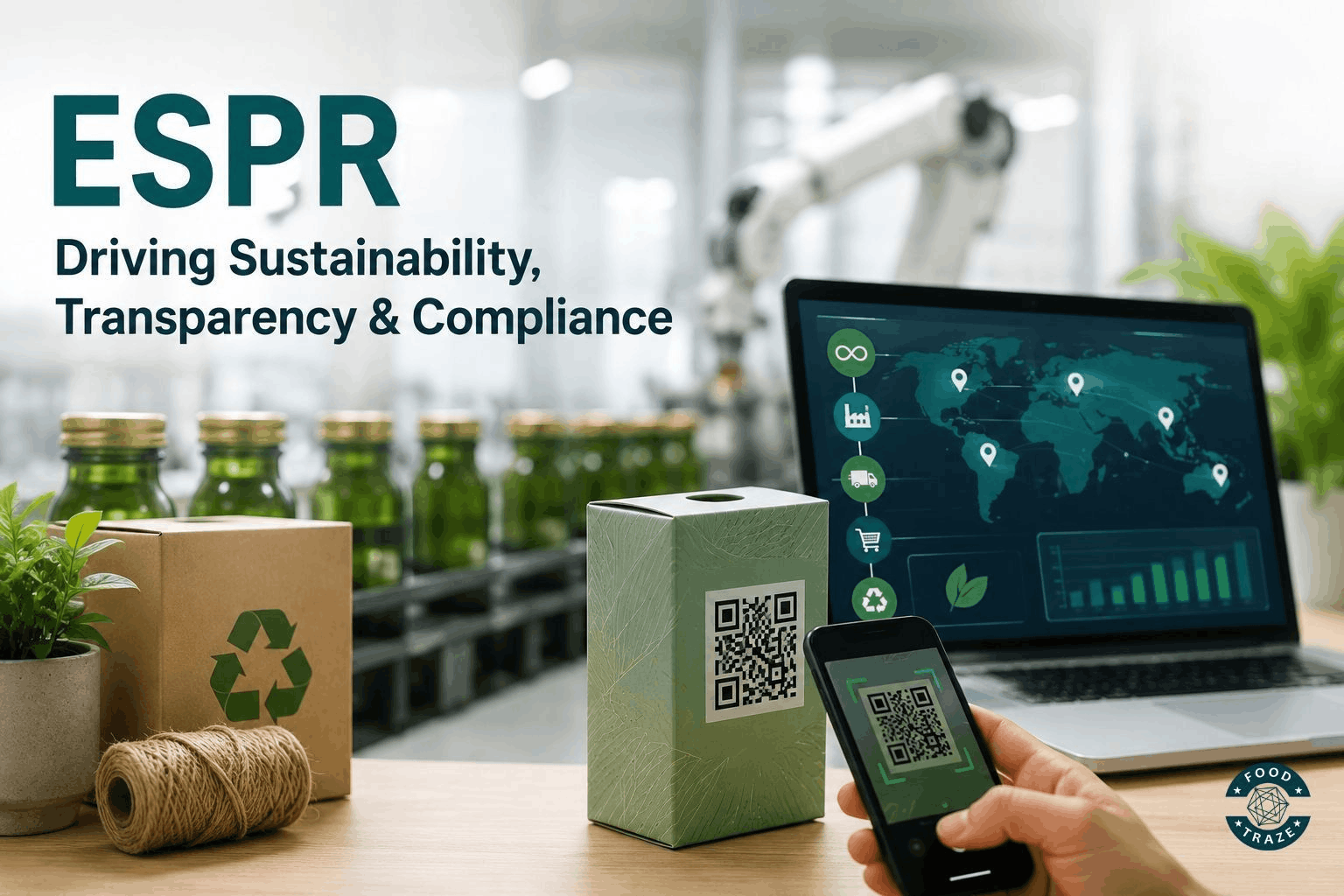
The Impact of ESPR: Driving Sustainability, Transparency, and Compliance
Learn how the EU's Ecodesign for Sustainable Products Regulation (ESPR) is transforming sustainability, product transparency, traceability, and compliance. Discover how FoodTraze helps businesses prepare for evolving ESPR requirements.
What is ESPR?
The Ecodesign for Sustainable Products Regulation (ESPR) is a European Union regulation aimed at improving the environmental sustainability of products placed on the EU market.
Unlike earlier eco-design rules, which mainly focused on energy-related products, ESPR has a much broader scope. It looks at the full lifecycle of a product from raw materials and production to use, repair, reuse, and end-of-life disposal.
The main goals of ESPR are to:
- Improve product durability and lifespan
- Make products easier to repair and maintain
- Support reuse and recycling
- Increase resource efficiency
- Reduce environmental impact across the product lifecycle
- Support the circular economy
- Improve transparency through product sustainability information
In simple terms, ESPR encourages businesses to design products that last longer, waste less, and are easier to recover or reuse.
Key Requirements of ESPR
ESPR introduces several sustainability-focused product requirements that may apply depending on the product category.
Durability
Products should be built to last longer and withstand normal use. Better durability means fewer replacements, less waste, and lower environmental impact.
Repairability
Products should be easier to repair and maintain. This may involve access to spare parts, repair instructions, and service information. Repairable products help extend product life and reduce unnecessary disposal.
Reusability
ESPR encourages products and components to be reused whenever possible. Reusable parts reduce the need for new raw materials and support circular economy goals.
Upgradability
Some products should be designed so that parts can be upgraded instead of replaced entirely. For example, certain electronic devices may allow upgrades to batteries, memory, or other components.
Recyclability
Products should be easier to dismantle and recycle at the end of their life. This includes considering material selection, component separation, and recovery of valuable resources.
Resource Efficiency
Resource efficiency means using fewer raw materials, less energy, and less water throughout the product lifecycle. Businesses may need to review how products are made and where waste can be reduced.
Environmental Performance
ESPR also focuses on reducing the overall environmental impact of products. This may include carbon emissions, energy use, material consumption, waste generation, and water usage.
How ESPR Affects Businesses Outside the EU
Food safety is one of the most important responsibilities in the food industry. Product traceability helps businesses quickly identify contaminated batches, isolate affected products, and prevent unsafe food from reaching consumers.
Digital traceability also supports routine inspections, quality assurance programs, and food safety certifications by maintaining accurate and verifiable records throughout the product lifecycle.
With accurate tracking records, organizations can investigate quality issues faster, identify the source of contamination, and take corrective action before problems escalate.
Why Non-EU Businesses Must Comply
Consumers today expect complete transparency about the food they purchase. They want to know where ingredients come from, whether products meet safety standards, and if businesses follow sustainable sourcing practices.
This visibility reduces business risks, improves collaboration between supply chain partners, and enables faster, data-driven decision-making.
For manufacturers, distributors, exporters, retailers, and food service providers, traceability provides complete visibility across the supply chain. Instead of relying on disconnected spreadsheets or manual documentation, organizations can monitor every movement of products through a unified digital platform.
Opportunities for Early Adopters
Product traceability is the ability to track and verify a food product's journey from its origin to the final consumer. Every stage—including farming, processing, packaging, transportation, storage, and distribution—is digitally recorded, creating a complete and transparent history of the product.
As food supply chains become increasingly complex, digital traceability has become essential for improving operational efficiency, ensuring food safety, and meeting global regulatory requirements.
Modern traceability platforms replace paper-based records with centralized digital systems that capture batch information, supplier details, certifications, quality inspections, and logistics data in real time. This enables food businesses to quickly identify where products originated, how they were handled, and where they were delivered.
Market Access and Customer Confidence
Food safety is one of the most important responsibilities in the food industry. Product traceability helps businesses quickly identify contaminated batches, isolate affected products, and prevent unsafe food from reaching consumers.
Digital traceability also supports routine inspections, quality assurance programs, and food safety certifications by maintaining accurate and verifiable records throughout the product lifecycle.
With accurate tracking records, organizations can investigate quality issues faster, identify the source of contamination, and take corrective action before problems escalate.
Establish Compliance Governance
Product traceability is the ability to track and verify a food product's journey from its origin to the final consumer. Every stage—including farming, processing, packaging, transportation, storage, and distribution—is digitally recorded, creating a complete and transparent history of the product.
As food supply chains become increasingly complex, digital traceability has become essential for improving operational efficiency, ensuring food safety, and meeting global regulatory requirements.
Modern traceability platforms replace paper-based records with centralized digital systems that capture batch information, supplier details, certifications, quality inspections, and logistics data in real time. This enables food businesses to quickly identify where products originated, how they were handled, and where they were delivered.
Conclusion
Consumers today expect complete transparency about the food they purchase. They want to know where ingredients come from, whether products meet safety standards, and if businesses follow sustainable sourcing practices.
This visibility reduces business risks, improves collaboration between supply chain partners, and enables faster, data-driven decision-making.
For manufacturers, distributors, exporters, retailers, and food service providers, traceability provides complete visibility across the supply chain. Instead of relying on disconnected spreadsheets or manual documentation, organizations can monitor every movement of products through a unified digital platform.