
Cloud-based traceability solutions for secure and transparent food supply chains.
 Foodtraze TRUST QR
Give consumers instant access to trusted product information through secure QR codes.
Foodtraze Complaince
Simplify compliance with accurate, transparent, and verifiable supply chain records.
Foodtraze Sustainablity
Build transparent supply chains that support responsible sourcing and sustainability.
Foodtraze Vendor Trust Network
Connect with trusted vendors and improve transparency across your supply network.

Seamlessly connect FoodTraze with your existing business systems and workflows.

Secure and tamper-proof blockchain infrastructure for trusted food traceability.
Hypeledger Fabric
Enterprise blockchain technology designed for secure and scalable traceability.
Why Blockchain?
Discover how blockchain enables secure, transparent, and trusted food traceability.
Opensource
Explore open-source technologies that power transparent and trusted food systems.
Deployment Guide
Follow simple guidance to deploy and integrate FoodTraze into your business.
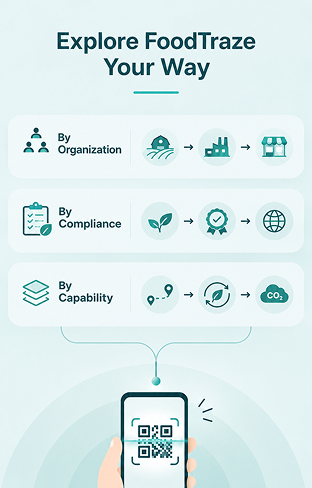
By Organization
See how FoodTraze adapts to your role across the food supply chain, from farm to retail.
Food producers
Track your product from farm to shelf with verifiable, tamper-proof records at every stage.
Importers
Verify supplier claims and customs documentation before goods ever reach your warehouse.
Exporters
Meet destination-country requirements with digital certificates and real-time shipment tracking.
Food Processors
Monitor ingredients, batches, and processing steps with full chain-of-custody visibility.
Government Agencies
Access audit-ready records across supply chains to enforce food safety standards.
Regulatory Authorities
Monitor compliance in real time with transparent, standardized traceability data.
Research Institutions
Access anonymized supply chain data to study food systems and safety trends.
NGOS
Monitor ethical sourcing and sustainability commitments across global supply networks.
Cooperatives
Give member farmers shared visibility and fair, transparent market access.
Certification Bodies
Issue and verify certifications digitally, backed by immutable supply chain records.
Brand owners
Enable brand owners to track products across the supply chain, improve transparency, ensure compliance, and build consumer trust with end-to-end food traceability.
By Compliance
Stay ahead of global food safety and sustainability regulations with built-in compliance tools.
ESG Reporting
Track and report environmental, social, and governance metrics automatically.
Carbon Farming
Measure and verify carbon sequestration practices across your supply chain.
GlobalG.A.P.
Meet GlobalG.A.P. certification requirements with automated field-to-farm records.
ISO 22000
Maintain ISO 22000 food safety management system documentation effortlessly.
HACCP
Document critical control points and hazard analysis in real time.
Digital Product Passport (DPP)
Generate EU-compliant digital passports with full product lifecycle data.
GS1
Standardize product identification with GS1-compliant barcodes and data.
FSMA 204
Comply with FDA traceability rules for high-risk food commodities.
EUDR
Prove deforestation-free sourcing to meet EU Deforestation Regulation requirements.
By Capability
Explore the core features that power traceability, transparency, and trust across your operations.
Food Traceability
Trace every product from raw material to final consumer.
Supply Chain Transparency
Give stakeholders real-time visibility into every stage of production.
Sustainability Management
Promote sustainability through responsible resource and impact management.
Carbon Footprint Tracking
Measure emissions across production, processing, and transportation.
TrustQR Consumer Transparency
Let shoppers scan a QR code to see a product's full journey.
Vendor Trust Network
Verify and manage supplier credentials across your entire network.
Product Recall Management
Identify and contain affected batches within minutes, not days.
Digital Product Passport
Attach verified lifecycle data to every product you sell.
Geo-Digital Farm Mapping
Map farm boundaries and land use with satellite-verified geolocation.
Regulatory Compliance
Ensure compliance with food safety regulations and standards.
 Crops & Grains
From seed to shipment, capture every milestone across cultivation, harvesting, storage, and distribution
 Coffee, Tea & Cocoa
Follow every bean and leaf from its origin to processing, packaging, and the final destination.
 Spices & Herbs
Bring transparency to every batch with detailed records from cultivation and harvesting to processing and delivery.
 Plantation Crops
Connect plantation activities, harvests, processing, and distribution into one transparent product journey
 Fruits & Vegetables
Create a transparent journey for fresh produce across farms, packing facilities, logistics, and retail.
 Seafood & Aquaculture
Trace seafood from its source through harvesting, processing, cold-chain movement, and final delivery.
 Dairy
Track dairy from farm to distribution with complete traceability.
 Meat & Livestock
Follow livestock and meat products from origin to processing and distribution with trusted supply chain records
 Poultry & Eggs
Track poultry & eggs across farming, collection, processing, packaging, and distribution for greater transparency.
 Processed & Packaged Foods
Connect raw ingredients and production batches with processing, packaging, logistics, and final products.
 Organic & Specialty Products
Showcase trusted origins with transparent sourcing, certification, sustainability, and product journey data.
 Use cases
Discover how FoodTraze supports traceability across the food supply chain.
 Success Stories
See how businesses use FoodTraze to improve transparency and traceability.
 White Papers
Explore in-depth insights into blockchain, food traceability, and sustainability.
 Blog
Find technical guidance for integrations, APIs, and platform development.
 Product Roadmap
Explore planned features, upcoming improvements, and product direction.
 Our Journal
Stay updated on FoodTraze events, announcements, and industry participation.